Baby Highland Cow Embroidery Design Review
First Impressions: Charm, Clarity, and Commercial Potential
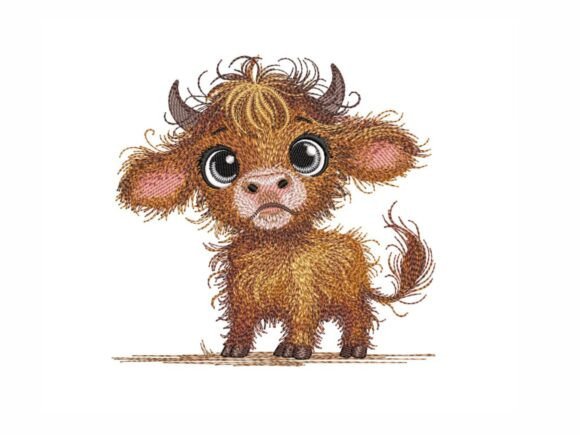
As an embroidery designer who’s stitched hundreds of animal motifs for Etsy shops, boutique baby lines, and custom apparel clients, I opened the Baby Highland Cow embroidery file with a clear question: Does this design translate from screen to stitch—and from stitch to sale? Visually, it delivers immediate warmth. The calf is softly rounded, with expressive eyes and delicate horns, framed by subtle floral flourishes that add texture without clutter. It’s not cartoonish, nor overly realistic—it strikes that rare balance between whimsy and refinement. That duality makes Baby Highland Cow feel like a design built for real-world use, not just digital browsing.
A Natural Fit for Thoughtful Handmade Projects
I tested Baby Highland Cow across several product categories I regularly produce: organic cotton baby blankets, unbleached linen kitchen towels, heavyweight cotton tote bags, and ribbed knit sweatshirts. Its scale and detail hold up beautifully at 3.5"–4.5" widths—ideal for medium hoop sizes (5x7" or larger). On a baby blanket corner, the floral accents read as gentle embellishment rather than visual noise. On a kitchen towel, the calf’s silhouette stays crisp even after two home washes—thanks to balanced satin and fill stitch distribution and moderate stitch density.
The design avoids problematic embroidery pitfalls: no micro-lettering, no ultra-thin running-stitch outlines that vanish on textured fabric, and no overlapping dense fills that cause puckering on stretchy knits. That makes Baby Highland Cow unusually reliable for commercial embroidery—especially when stitching for clients who expect consistency across batches.
Performance Across Real Fabric Surfaces
Stretchy fabrics: On a ribbed baby sweatshirt, I used lightweight cutaway stabilizer + tear-away topping. The floral elements stayed defined, and the calf’s face retained softness—no thread breakage or distortion. The design’s open negative space helped prevent stiffness.
Dark or heavy fabrics: Stitched on charcoal denim aprons, Baby Highland Cow gained quiet sophistication. Using high-contrast thread (cream on dark) emphasized its sculptural shape. No need for excessive underlay—just a single layer of medium-weight stabilizer kept the base stable without adding bulk.
Curved surfaces: For a baseball cap front panel, I resized down to 3.25". While some floral details softened slightly, the calf remained instantly recognizable. This confirms Baby Highland Cow is adaptable—not just for flat goods, but for wearable items where clarity matters most.
Patches & layered products: As an embroidered patch on twill fabric, it held clean edges and lifted well off the backing. The satin-stitched horns and floral centers created subtle dimension—valuable for handmade gifts where tactile appeal boosts perceived value.
What Baby Highland Cow Adds to Your Product Story
This isn’t just another animal motif—it’s a narrative shortcut. Buyers browsing nursery décor or farm-themed baby gear respond to emotional resonance first. Baby Highland Cow conveys gentleness, heritage, and handmade care in one compact composition. That translates directly to stronger product photography: the floral framing creates natural light-catching highlights, and the balanced proportions center beautifully in mockups.
For Etsy sellers, it elevates perceived value. A plain organic onesie becomes a curated heirloom piece when paired with this design. For craft fair vendors, it sparks conversation—“Is that a Highland calf? How sweet!”—which builds buyer trust faster than text descriptions ever could.
And for small-batch apparel decorators, Baby Highland Cow supports brand consistency. Whether used on a pillow cover, tea towel set, or baby milestone blanket, its cohesive mood helps unify a seasonal collection—without requiring custom illustrations.
Practical Notes Before You Stitch
- Always test first: Run a sample on scrap fabric matching your final substrate—even if you’ve stitched similar designs before. Thread tension shifts subtly across machines and fabric types.
- Check thread color contrast: The design relies on tonal variation between calf, florals, and background. On dark fabric, avoid low-contrast thread combos that mute definition.
- Review stitch density: While not excessively dense, the floral centers do use tighter fill stitches. Use appropriate stabilizer weight—lightweight for wovens, cutaway for knits—to prevent shadowing or gapping.
- Confirm hoop size compatibility: The full design fits comfortably in a 5x7" hoop, but verify dimensions in your embroidery software before resizing for smaller hoops (e.g., cap fronts).
- Compare light/dark mockups: Visualize how the design reads on both ends of your color palette. Some floral details may soften on very busy prints—so reserve it for solid or tone-on-tone backgrounds unless testing confirms otherwise.
- Inspect small details post-stitch: After trimming, check horn tips and petal edges for stray threads or skipped stitches—especially when using metallic or specialty threads.
- Verify licensing: Before selling finished items, review the Creative Fabrica product page for usage rights. This Baby Highland Cow embroidery file falls under the standard commercial license for physical products—but always confirm current terms.
Final Thoughts for Embroidery Professionals
Baby Highland Cow stands out in the Baby Animals category because it avoids cliché while remaining accessible. It’s detailed enough to feel intentional, simple enough to stitch reliably, and emotionally resonant enough to sell. I’ve already added it to my go-to folder for baby shower gifts, boutique nursery collections, and spring-themed craft fair lines.
It won’t replace every animal design in your library—but it fills a specific, valuable gap: elegant yet approachable, decorative yet durable, sweet without saccharine. If you’re sourcing embroidery files for handmade products that need to look thoughtful *and* hold up to real life, Baby Highland Cow earns its place—not as filler, but as a functional, market-ready machine embroidery design.