Floral Flutter: A Designer’s Real-World Embroidery Review
First Impressions: Grace, Flow, and Quiet Confidence
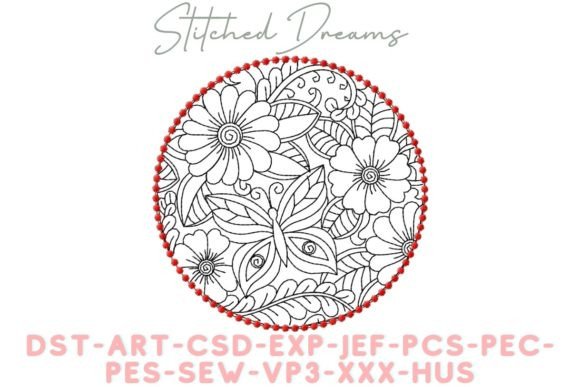
When Floral Flutter opens in my embroidery software, it doesn’t shout—it breathes. The butterfly isn’t posed or stiff; it’s mid-glide, wings angled just so, trailing softly over a loose, organic cluster of flowers. There’s no rigid symmetry, no forced centering—just natural movement and layered depth. As a designer who’s stitched hundreds of motifs for real clients and small-batch products, I immediately sense this isn’t a “filler” design. It carries quiet elegance, making it ideal for handmade products where subtlety reads as intention—not afterthought.
Where It Shines: From Tote Bags to Nursery Keepsakes
I recently tested Floral Flutter on a medium-weight cotton tote for a local boutique launch—and the result landed perfectly. The butterfly’s wings read clearly at 4.5 inches wide, with enough open space between petals and wingtips to avoid visual crowding. On sweatshirt embroidery? Yes—but only on the upper back or left chest, where fabric tension stays stable and the motif has room to breathe. It also translated beautifully onto a linen tea towel (using lightweight cutaway stabilizer), where the soft fill stitch in the flower centers held shape without stiffness.
For baby embroidery? Absolutely—especially on swaddle blankets or onesie hems. The gentle curves and absence of sharp angles or tiny isolated elements make it forgiving for delicate fabrics and frequent washing. As an embroidered patch? Less ideal out of the box—there’s no built-in border or dense satin stitch outline, so you’d want to add one for durability. But as a custom-applique-ready motif? Strong potential, especially if you pair it with a coordinating fabric scrap for the butterfly’s wings.
Where to Pause: Texture, Scale, and Fabric Reality
Floral Flutter demands thoughtful placement—not because it’s difficult, but because its charm lives in its delicacy. On highly textured fabrics like terry cloth or bouclé, the fine lines in the butterfly’s antennae and petal edges risk blending into the pile. On thin or stretchy fabric (think rayon blends or lightweight knits), skip the chest pocket of a t-shirt unless you’re using firm tear-away + light cutaway stabilizer underneath. And on dark fabric? Test thread colors first—the original file likely assumes light backgrounds; switching to matte black or deep navy thread on charcoal fabric requires adjusting density to prevent dullness.
Curved surfaces—like caps or curved pillow covers—call for caution. The lower flower cluster extends slightly downward, which can distort on tight curves unless you resize proportionally and re-hoop carefully. Also, avoid placing it near seams or darts where fabric shifts during hooping. This isn’t a “drop-in-and-stitch” design for beginners—it rewards attention to grain, tension, and stabilizer choice.
What It Does for Your Product—and Your Customer
Stitched well, Floral Flutter elevates perceived value instantly. It reads as handmade *and* intentional—not mass-produced clip art. Etsy sellers tell me customers comment on how “light” and “alive” the butterfly feels, even in photos. That emotional resonance translates directly to trust: when a buyer sees this on a personalized gift or boutique sweatshirt, they don’t just see embroidery—they see care. For craft business branding, it fits cleanly into spring collections, botanical-themed shops, or gender-neutral nursery lines without leaning into cliché.
It also works quietly across audiences. Teens respond to its soft edge; grandparents appreciate its timelessness; wedding clients love it for bridesmaid robes or guest towels. That versatility is rare—and valuable—when you’re curating digital embroidery files for resale or building a cohesive line of design assets.
Designer Notes You’ll Actually Use
- Always test on scrap fabric first—especially with your exact stabilizer combo and thread brand. Stitch density can shift dramatically between machines.
- Review small details in black-and-white mockups. The butterfly’s wing veins and petal outlines must hold contrast against both light and dark backgrounds.
- Confirm hoop size before digitizing adjustments. If your machine maxes out at 4x4”, you may need to simplify outer flower elements—or embrace the cropped version as a deliberate design choice.
- Check thread color contrast on actual fabric swatches, not just screen previews. What looks crisp on white cotton may disappear on oatmeal linen.
- Use proper stabilizer for your base fabric—lightweight cutaway for knits, tear-away for stable wovens, and fusible + tear-away for nap-free velvet or corduroy.
- Verify licensing terms before selling finished products or bundling Floral Flutter into digital embroidery kits. Commercial use rights aren’t automatic—even for clothing or embroidery files.
Final Thought: Not Just Another Butterfly
In a market flooded with busy, over-digitized motifs, Floral Flutter stands out by honoring negative space, rhythm, and restraint. It’s not flashy—but it’s memorable. As a machine embroidery design, it invites collaboration: between stitcher and fabric, between maker and customer, between idea and finished product. Whether you’re stitching a custom apron for a chef friend, prepping holiday embroidery for your Etsy shop, or building a signature look for your small shop product line, this design earns its place—not as decoration, but as quiet storytelling in thread.
If you treat it with respect for its flow, its scale, and its context, Floral Flutter won’t just embroider well. It’ll resonate.