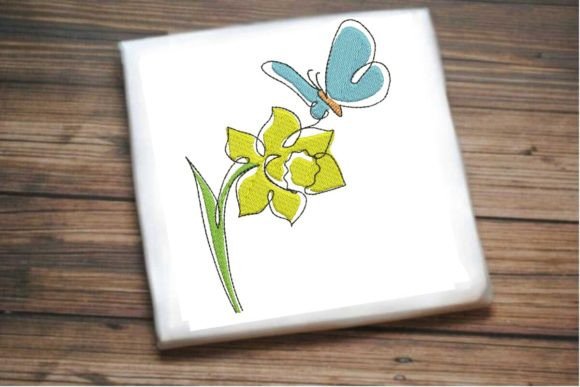
Daffodil and Butterfly Single Line
First Impression: Minimalist Elegance with Quiet Charm
As an embroidery designer who’s prepped over 200 craft fair booths, my first glance at Daffodil and Butterfly Single Line says “refined spring”—not loud, not fussy, but unmistakably intentional. The title alone evokes lightness and movement: daffodils suggest renewal and quiet confidence; butterflies add gentle whimsy without tipping into cutesy. Paired with “Single Line,” it signals a clean, modern aesthetic—far from dense fill-stitch florals or vintage cottagecore overload. This isn’t a farmhouse stencil or a festive motif—it’s elegant minimalism built for discerning handmade shoppers who value subtlety and craftsmanship.
Where It Shines on Craft Fair Products
Tote bags: A single-line daffodil + butterfly works beautifully centered on the lower corner of a natural canvas tote—small enough to feel intentional, large enough to catch the eye as customers browse. It reads as premium, not generic.
Aprons and tea towels: Here, Daffodil and Butterfly Single Line excels as an accent—not a dominant chest logo, but a delicate detail near the hem or pocket edge. On linen-look tea towels, it reads as artisanal, not mass-produced. Customers consistently pause longer at aprons with this kind of thoughtful, restrained embroidery.
Patches and fabric pouches: As an embroidered patch, it holds shape well—no bulky fills to distort backing. On small drawstring pouches (think gift-ready lavender sachets or seed packet holders), its slim profile ensures clarity even at 2.5” wide. It feels giftable, not craft-supply-bin.
Pillow covers and caps: Use caution here. On curved cap surfaces, the single-line flow can stretch or distort if not digitized with underlay and pull compensation. For pillow covers, keep it centered and medium-scale (3.5–4”)—too small, and the butterfly wing details vanish; too large, and the line loses its airy quality.
Booth samples and printable mockups: This design photographs exceptionally well. Its contrast, rhythm, and negative space translate cleanly to Instagram posts, Etsy banners, and printed booth signage. Pair it with soft beige, sage, or oatmeal fabrics in your mockups—it avoids looking washed out or overly stark.
Production Realities: Speed, Clarity, and Consistency
For small shop owners batching 30–50 pieces before a fair, Daffodil and Butterfly Single Line is a smart pick. It’s fast to hoop, low in stitch density, and forgiving across most midweight cottons and linens. You’ll get consistent results across tote bags, aprons, and patches without constant tension tweaks—provided you use appropriate stabilizer (light cutaway for knits, tear-away for stable wovens).
It’s instantly legible at a glance—no squinting needed. That matters when customers scan your table in under three seconds. Unlike intricate multi-color florals, this design doesn’t require color-matching decisions on the spot. Two thread colors (e.g., butter yellow + pale sky blue) cover both elements elegantly.
It scales cleanly: works at 2.2” for a lapel pin patch, 3.8” for a market bag, and up to 5” on a large pillow cover—without losing definition or feeling top-heavy. That versatility means fewer design files to manage and more cohesive branding across your product line.
Careful-Use Notes Every Designer Should Check
- Avoid dark or heavily textured fabrics unless you’ve tested contrast—fine single lines disappear on charcoal terry cloth or black burlap.
- Don’t shrink below 1.8”—the butterfly’s antennae and daffodil trumpet lose distinction, reading as blobs instead of grace notes.
- Curved surfaces (caps, curved pouches) demand test runs—even minimalist lines warp without proper hooping and stabilizer support.
- Thick fabrics like denim or quilted cotton may require topping (like water-soluble film) to prevent thread nesting in the daffodil’s narrow stem curve.
- Always verify spacing between elements—a tight gap between flower and butterfly risks stitching overlap on slower machines, causing thread breaks or skipped stitches.
Why It Strengthens Your Booth & Brand
Daffodil and Butterfly Single Line quietly elevates perceived value. Handmade customers associate clean line work with intentionality—and intentionality sells. It supports brand consistency across categories: same design on a tea towel, a patch, and a tote reads as a curated collection, not a grab-bag of motifs. At craft fairs, where visual noise is high, its breathing room stands out. Shoppers remember the calm elegance—not the clutter.
It also invites engagement. “Is that hand-drawn?” and “Do you make the pattern?” are common questions—opening doors to storytelling about your process, materials, and care. That human connection drives repeat buyers and word-of-mouth referrals far more than flashy graphics ever will.
Essential Embroidery Designer Checks Before Production
- Test Daffodil and Butterfly Single Line on scrap fabric matching your final product—especially for texture and drape.
- Confirm thread contrast on your actual base fabric—not just on screen.
- Review spacing and line continuity in your embroidery software; zoom in on the butterfly’s wingtips and daffodil’s corona.
- Verify hoop size compatibility—some single-line designs assume 4x4, but others push 5x7 for optimal flow.
- Inspect stitch density: true single-line should avoid overlapping passes that create unintentional fills.
- Choose stabilizer based on fabric—not habit. Lightweight cutaway prevents puckering on tea towels; tear-away keeps patches crisp.
- Create at least one real finished product—not just a digital mockup—before committing to batch production.
- Compare how it looks on light vs. medium fabric tones. Does the line hold presence? Does it read as delicate or fragile?
- Confirm commercial licensing status. If selling finished goods, ensure your digital embroidery file license permits resale of physical products—many “instant download” listings restrict commercial embroidery use.
Final Thought for Etsy Sellers & Boutique Makers
Daffodil and Butterfly Single Line isn’t just another floral embroidery—it’s a strategic asset. In a crowded market of oversized sunflowers and scripted quotes, it offers differentiation through restraint. It performs across categories, photographs with integrity, and resonates with customers seeking beauty that breathes. For craft fair sellers, it’s booth-ready elegance. For digital sellers, it’s a versatile machine embroidery design that converts well in the Single Flowers niche. Just remember: minimalism only works when executed with precision. Test, refine, and let the line speak for itself.